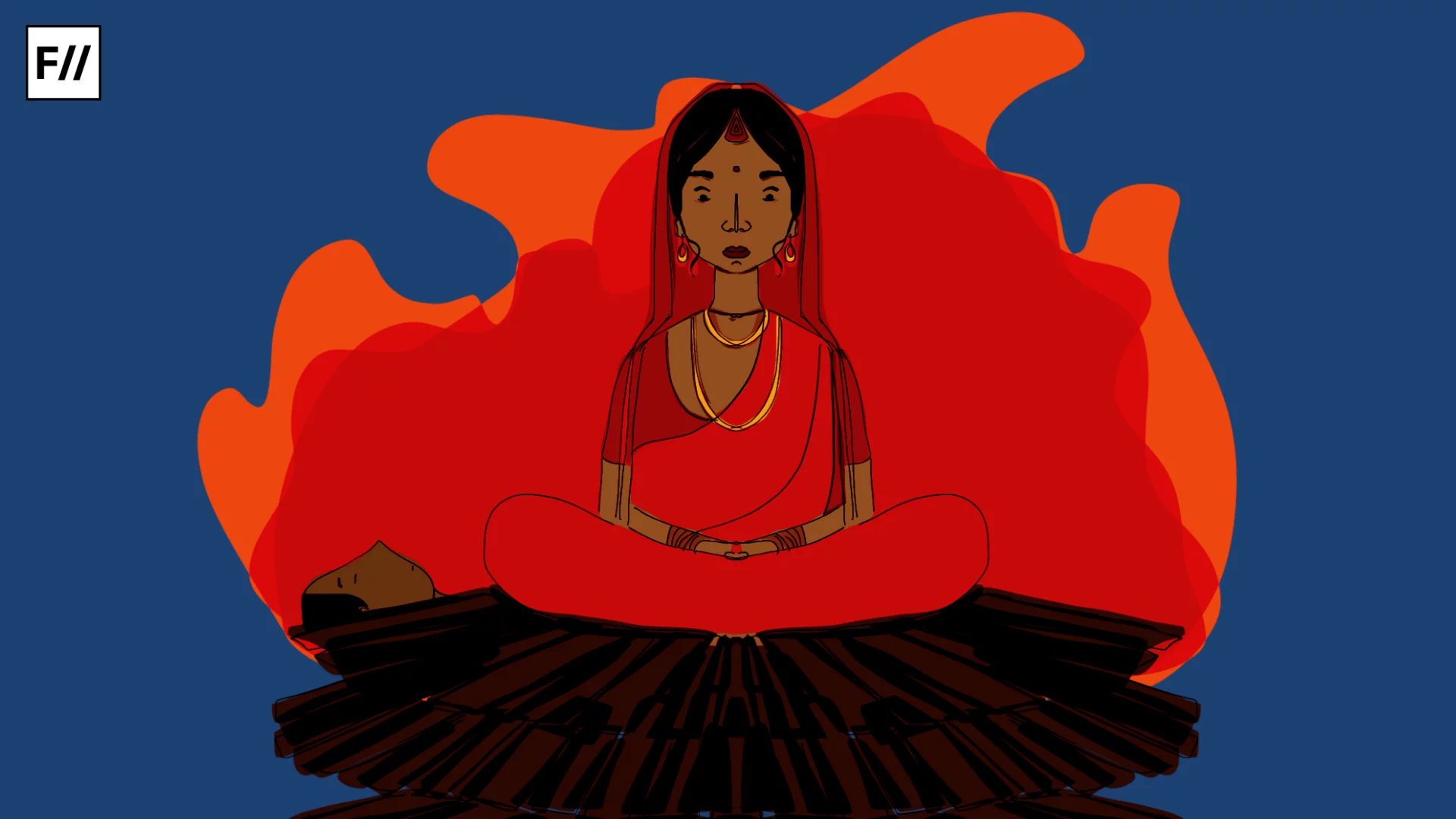
Sati has long been a site where its ritualistic meanings (an act of martyrdom) and its labelling as a barbaric practice come into conflict, often producing reformist and civilizing debates. However, in these discussions, the immolated woman herself is strangely missing. The focus tends to remain on the act of sati rather than on the woman who undergoes it. Both colonial and even some feminist readings have treated sati as a kind of spectacle, without fully engaging with the woman as a subject. In colonial discourse, especially within the language of the civilizing mission and writings by white women, sati was also used to justify intervention. From the early nineteenth century onwards, English women developed frameworks through which Indian women were to be “emancipated,” but these were deeply shaped by Christian evangelical ideas. In effect, this can be understood as a “rescuer” sort of encounter as well as an excuse for the colonial civilizing mission, where English women positioned themselves as saviours and Indian women as subjects in need of rescue, effectively shifting them from what can be called “brown patriarchy” into the fold of “white patriarchy”.
Modern scholarship tries to address this gap by bringing the woman back into the discussion. Drawing on scholars like Jyoti Atwal, Rajeshwari Sunder Rajan, and Claire Midgley, this piece attempts to rethink how the subjectivity of the immolated woman can be understood rather than erased.
Myth of the “Voluntary” Sati
As we see more closely, in the process of colonial knowledge production, Hindu shastric and Puranic texts were taken up and translated as a means to understand the society and the people over whom the British intended to rule. It is therefore not surprising that these very texts became crucial when questions of sati and the status of Hindu women were taken up within the colonial legal framework. And this engagement with puranic vyavasthas related to Sati, ended up with an idea of what constituted a ‘legal’ Sati (Atwal p. 237).
From the early nineteenth century onwards, English women developed frameworks through which Indian women were to be “emancipated,” but these were deeply shaped by Christian evangelical ideas.
Jyoti Atwal shows that historically, upper-caste Kshatriya women were seen as performing sati in order to protect or uphold their husband’s honour. However, when it comes to poorer women, a different dynamic emerges – at times, they were pushed toward the pyre as a way of escaping extreme poverty. In this sense, the act cannot be understood only in terms of ritual or honour; rather, their socio-economic conditions were actively shaping such decisions.
She raises an important question about why the colonial regime was so invested in certifying the idea of “voluntary sati.” Drawing on Lata Mani, she explains that this was tied to a broader British practice of reproducing and reinterpreting the “Hindu past,” through which colonialism itself helped construct such categories. In this process, the idea of pativrata also emerges, not merely as a textual ideal, but as something enacted and performed in specific contexts.
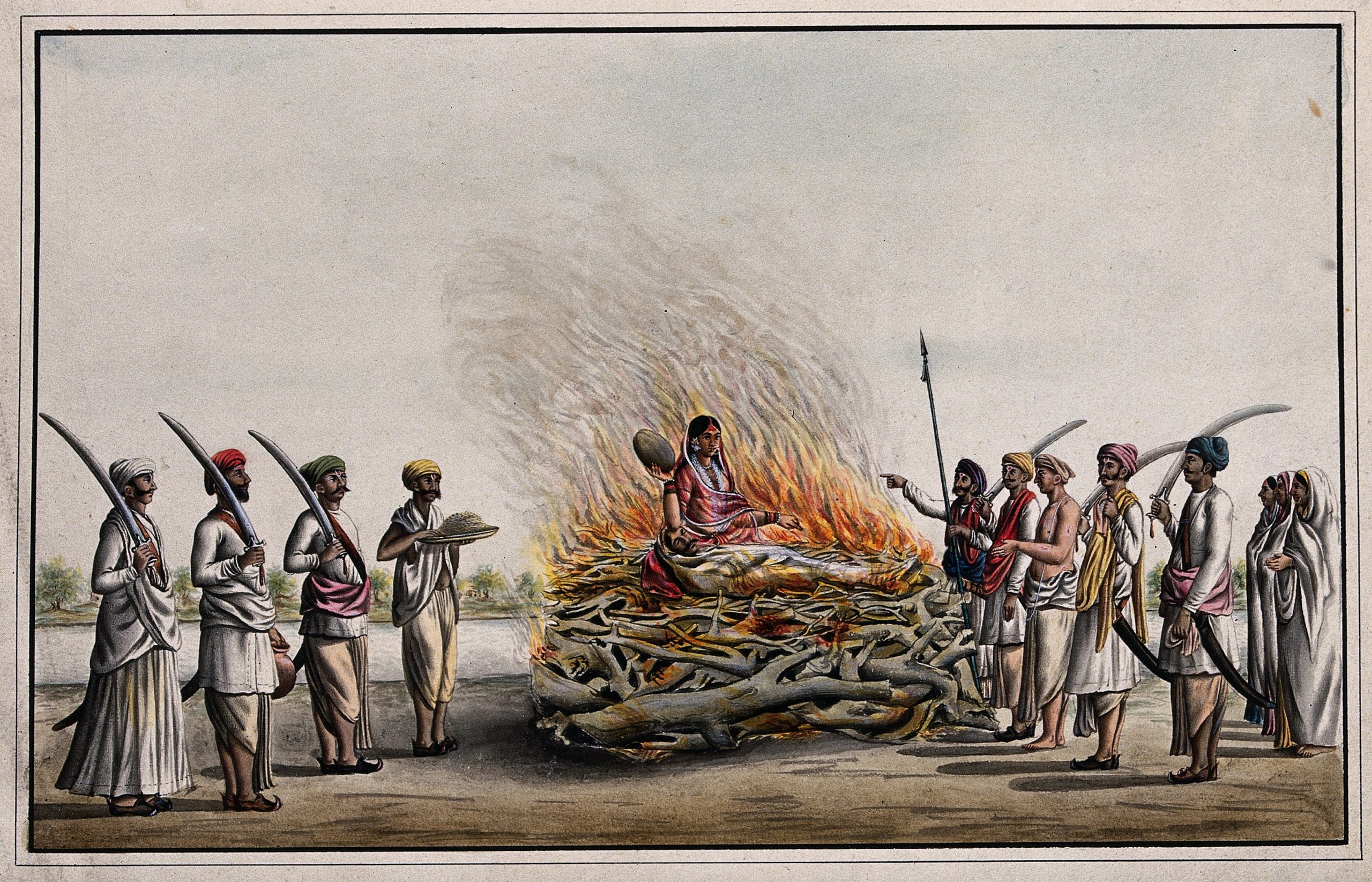
Atwal illustrates this through a case where a woman burnt herself fifteen years after her husband’s death, using his hookah, showing how such meanings were not fixed but produced in particular situations (Atwal, p. 243). At the same time, the campaign to suppress sati intensified, eventually leading to the abolition act of 1829, often seen as the outcome of missionary and civil society pressures in Britain.
What becomes visible, then, is a paradox: the British created a structure in which sati was condemned as a barbaric custom (which was itself a part of the larger civilizing mission), yet, through its legal, administrative, and discursive interests, the act itself was also sensationalized and, in some ways, sustained (Atwal, p. 261).
Missionary Women and Imperial Feminist Interventions
Clare Midgley argues that when English women entered anti-Sati movements in Britain, they played an active role, promoting female education, petitioning to Parliament, and participating in missionary work in India. However, their main focus was on Indian widows, whom they largely saw as victims. The concern was not only about widows dying on the funeral pyre but also about their inability to fulfil their “motherly” responsibilities (Midgley, p. 95). Gayatri Spivak thus opined that the colonial justification of Sati layered on the line “White men are saving brown women from brown men” (Midgley, p. 96).
Many “Local Ladies Associations” also emerged, viewing Indian women through the lens of suffering motherhood. As Midgley explains, missionary activity was not just about religious conversion but about establishing a kind of “Christianized household” in the East. At the same time, female education was being promoted, with figures like Mary Anne Cook contributing as teachers. When we talk about female agency, especially in a West–East framework, it becomes important to note that the issue of Sati gave British women an opportunity to participate in politics.
Like Englishmen, English women also saw themselves as “rescuers,” and they played their part by educating and uplifting Indian women (Midgley, p. 111). However, in Britain, the idea of Indian women’s emancipation was framed in terms of turning them into “good wives” within a Christian-style household. Therefore, Midgley brings here the notion of the “White Women” which she places at the centre of the discourse like the way Spivak placed “white men”. Thus, the movement from the Indian or Hindu patriarchy towards the Western or Christian patriarchy was promoted.
Pain and the Problem of Female Subjectivity
In modern scholarship on Sati, one of the biggest challenges has been how to understand women’s agency and subjectivity. Those who defended Sati argued that it was a voluntary ritual and even gave it a spiritual meaning, claiming that the woman became divine through the act. In this view, once she entered the funeral pyre, she was seen as beyond pain, almost “superhuman,” which helped glorify the practice. Rajeshwari Sunder Rajan highlights this through the case of Roop Kanwar, an 18-year-old woman whose death by Sati led to her village, Deorala in Rajasthan, being turned into a pilgrimage site (Rajan, p. 16).
Anti-Sati activists argue that the practice was not voluntary but involved both physical force and psychological pressure.
Rajan uses the idea of pain and resistance to show how complicated female subjectivity really is. Anti-Sati activists argue that the practice was not voluntary but involved both physical force and psychological pressure. To better understand the problem of agency, Rajan suggests that we should shift our focus from seeing Sati simply as “death” to seeing it as “burning” or “suffering” (Rajan, p. 19). This shift is important because even if a woman was placed on the pyre through coercion, the moment she resists or tries to escape, she expresses her humanity, her ability to feel pain and fear. That moment of resistance shows that she is not becoming a deity but remains a human being experiencing intense suffering.
To understand the debate around Sati, we have looked at multiple perspectives, be they colonial missionaries, Indian reformers, or imperial feminists. Its abolition in colonial India was strongly influenced by the Bengal Renaissance, where reformers like Raja Rammohun Roy and Ishwar Chandra Vidyasagar strongly argued against the practice.
At the same time, the British used the issue of Sati to justify their “civilizing mission,” taking Indian women from this barbaric Hindu household and patriarchy towards Christianised households where they would not have to face such cruelty and they can play their motherly roles at ease. This often sensationalizing the ritual to present themselves as morally superior. Thus, alongside the notion of white men’s burden we can also see at work what can be called as white women’s burden.
Over time, many intellectuals engaged with Sati and produced different kinds of interpretations around it. Later, historians revisited the debate and shifted the focus. They brought in questions of victimhood, silenced agency, and power structures. Instead of seeing Sati only as a practice that was legally abolished, they explored its deeper social and cultural meanings.
So overall, the debate on Sati becomes much more complex when we go beyond just its abolition and start looking at issues of agency, representation, and power.
References
Atwal, Jyoti “Foul unhallow’d fires: Officiating Sati and the Colonial Hindu Widow in the United Provinces”, Studies in History, 29.2 (2013): 229-272
Midgley, Clare “Female emancipation in an imperial frame: English women and the campaign Against Sati (widow-burning) in India, 1813-30”, Women’s History Review, 9: 1, 2000, pp. 95-121
Rajan, Rajeshwari Sunder Real and Imagined Women: Gender, Culture and Postcolonialism, Routledge, London, 1993, pp. 15-38 & 39-60
About the author(s)