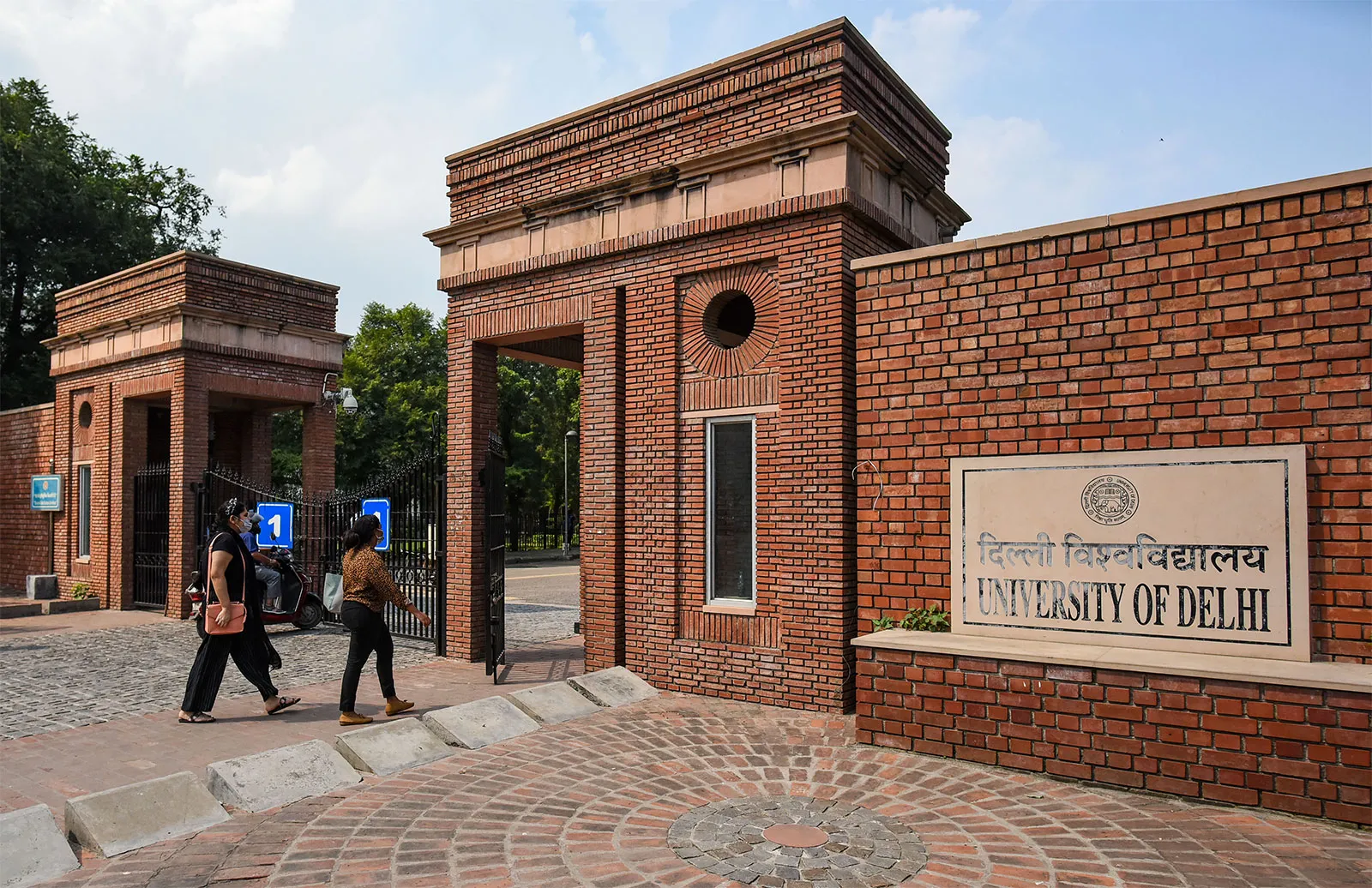
On Eid-ul-Adha, while much of the country observed a public holiday, students at Delhi University (DU) walked into examination halls. The exam began at 9:00 AM; at 9:28 AM, the University’s official X (formerly Twitter) account posted an important exam update, informing students that those unable to appear due to Eid would have the option to retake the exam after July 4. However, by the time this update was posted, students had started writing their papers.
A few days earlier, on May 25th, after DU released a notification clarifying that it would be a holiday on May 28 but exams would be held as per schedule, three separate writ petitions were filed before the Delhi High Court under Article 226 of the Constitution, seeking postponement of the examinations. The petitions argued that scheduling exams on a gazetted holiday was arbitrary and violated various fundamental rights under Articles 14, 15, 21, 25, 26, and 29.
The University’s counsel responded that students from minority communities who wished to observe Eid could email the Dean of the Faculty of Law by May 27, that is, one day before the exam, and their paper would be rescheduled. Justice Jasmeet Singh accepted this and disposed of the petitions, observing that the University’s stand was fair and reasonable. Even this limited relief applied only to Law Faculty students. Thousands from other departments had no options at all.
Meanwhile, multiple student organisations approached the Vice Chancellor (VC), Controller of Examinations (CoE), and the Registrar of DU in order to raise concerns about exams on Eid. However, this was in vain. The day before Eid, students gathered near the examination branch of DU to demand a postponement. Videos circulating on various news channels and on social media showed security personnel outside the exam branch brutally dragging and manhandling the students. Hundreds of security guards were deployed, though the University denied any scuffle.
What looked like a choice on paper didn’t feel like a choice in practice. Therefore, decisions were made under pressure, in haste, without clarity, time, and in the absence of viable alternatives. However, the actual issue isn’t whether an alternative was offered or not. The issue is who was asked to adjust and why this keeps happening.
In reality, what felt reasonable in a courtroom seemed very different inside a classroom. Students were given only one day to decide. That is too little time to process the confusion and consequences. The official communication came after the exam had already begun. Uncertain about what opting out would mean for their results or their schedule, many students simply chose to appear for their exams. What looked like a choice on paper didn’t feel like a choice in practice. Therefore, decisions were made under pressure, in haste, without clarity, time, and in the absence of viable alternatives. However, the actual issue isn’t whether an alternative was offered or not. The issue is who was asked to adjust and why this keeps happening.
Who was the academic calendar built for?
Diwali or Dussehra don’t require an opt-out email. Holi doesn’t require students to justify their absence. These holidays are seamlessly built into the academic calendar, without any requirement to declare your identity or seek permission from administration. However, for Eid, the burden shifts to the student. They must first identify themselves, make a request, and then wait for approval to observe what the institution has officially acknowledged as a holiday. This isn’t an isolated administrative failure. It is a pattern. And these patterns tell us something about who these institutions were built for and who is excluded.
Diwali or Dussehra don’t require an opt-out email. Holi doesn’t require students to justify their absence. These holidays are seamlessly built into the academic calendar, without any requirement to declare your identity or seek permission from administration. However, for Eid, the burden shifts to the student.
This pattern of exclusion becomes clear when compared with other scheduling decisions made by the same administration. During the same exam cycle, DU rescheduled multiple postgraduate and professional examinations between May 20 and 25 due to ‘unavoidable circumstances’, and directed departments to prepare fresh date sheets. The ‘unavoidable circumstances’ weren’t disclosed; however, students have their guesses, such as other major examinations that fall on the same date or due to political events.
Last year, the university, without any hesitation, rescheduled exams for students affected by Operation Sindoor. This was announced by the institution well in advance, and students were given a reasonable amount of time to apply. There was no requirement for a last-minute email to the dean, nor was there a notice arriving after the exams had begun. This clearly shows that entire examination windows have been revised multiple times when the situation called for it. The means to reschedule examinations clearly exists. The question is when it is exercised and for whom.
Further, opting to take the exam later comes with consequences for students. DU is set to wind up all its exams and have its summer vacation from June 16. The students who opted out will have to take their exams during this break. While others finally get some time to rest, these students will continue to have to study. They will carry the stress of examinations for longer, and will lose their opportunity to get an annual break. In addition, questions about evaluation consistency follow: Will the exam be equally difficult? Will the marking be fair? Will they be discriminated against or penalised? These are natural questions to arise because while institutions might intend to be fair, such an intention may not necessarily translate to reality.
This is also not limited to students. Teaching and non-teaching staff were also expected to be present on Eid as invigilators and administrative and logistical staff for conducting the exams. Students were at least given a last-minute opt-out, even though it was meaningless, but staff weren’t offered any choice at all. And this isn’t the first time. DU drew attention in 2023 for asking staff to work on Eid. Teachers’ organisations, such as the Democratic Teachers Front, called it an insensitive and intentional attempt to exclude a particular community. Yet the same thing has been repeated and accepted with little resistance. That tells us something deeper: how this has been normalised, when it is anything but.
Exclusion by design
This is part of a broader culture in which different religions are treated differently on the same campus. Festivals associated with certain religions are routinely celebrated and seamlessly incorporated into institutional spaces. Delhi University is a state-run institution with no religious affiliation. It is a central university where students from diverse religious and social backgrounds study. Despite this, students who wish to celebrate their festival on a gazetted holiday often face backlash and must rely on permissions, requests, and last-minute approvals. That disparity matters.
Problematic comments are conveniently called ‘jokes’ in casual conversations, but they reflect a wider uneasiness surrounding Muslim religious practice in educational institutions like DU. Thus, such scheduling decisions don’t exist in a vacuum; they are symptomatic of an intolerant climate.
Selective diversity isn’t diversity. And beyond the exam decision, some students have experienced discomfort with how Eid is discussed in student circles. Problematic comments are conveniently called ‘jokes’ in casual conversations, but they reflect a wider uneasiness surrounding Muslim religious practice in educational institutions like DU. Thus, such scheduling decisions don’t exist in a vacuum; they are symptomatic of an intolerant climate.
This isn’t about personal religious practices alone. Not every Muslim student actively celebrates Eid, and it is not exclusively celebrated by Muslim students, either. But that is not what matters here. The concern is regarding how institutions are designed, about which communities’ lives and rhythms are built into the system by default, and which ones must continually request permission to be considered.
It’s unsettling to be in a place where the default was never built with people like me in mind. The experience of being made to feel secondary in one’s own country, in one’s own university, is not easy to articulate. Yet it is a feeling that is difficult to overlook.
Growing up in a Muslim family in rural Kerala, where people shared the same faith and celebrated the same festivals, I never felt that my identity needed any explanation. Coming to DU felt like being thrown into a parallel universe. I have witnessed how institutions that appear neutral can marginalise people from minority communities. It’s unsettling to be in a place where the default was never built with people like me in mind. The experience of being made to feel secondary in one’s own country, in one’s own university, is not easy to articulate. Yet it is a feeling that is difficult to overlook.
Universities are meant to be spaces where diversity is not just recognised but accommodated without excuses. Inclusion that depends on email requests and administrative approvals is not inclusion; it is permission. The court found the University’s argument fair because, from a procedural standpoint, there was an option given to students. But for many students, especially Muslim students at DU, that option was meaningless. The expectation is not that the University should extend special privileges to Muslim students, but that they should be treated the same as everyone else. The fact that this still requires petitions, pressure, and protests shows that equality does not extend to all. For some, it remains conditional, something that must be requested, negotiated, and fought for every single time.
About the author(s)