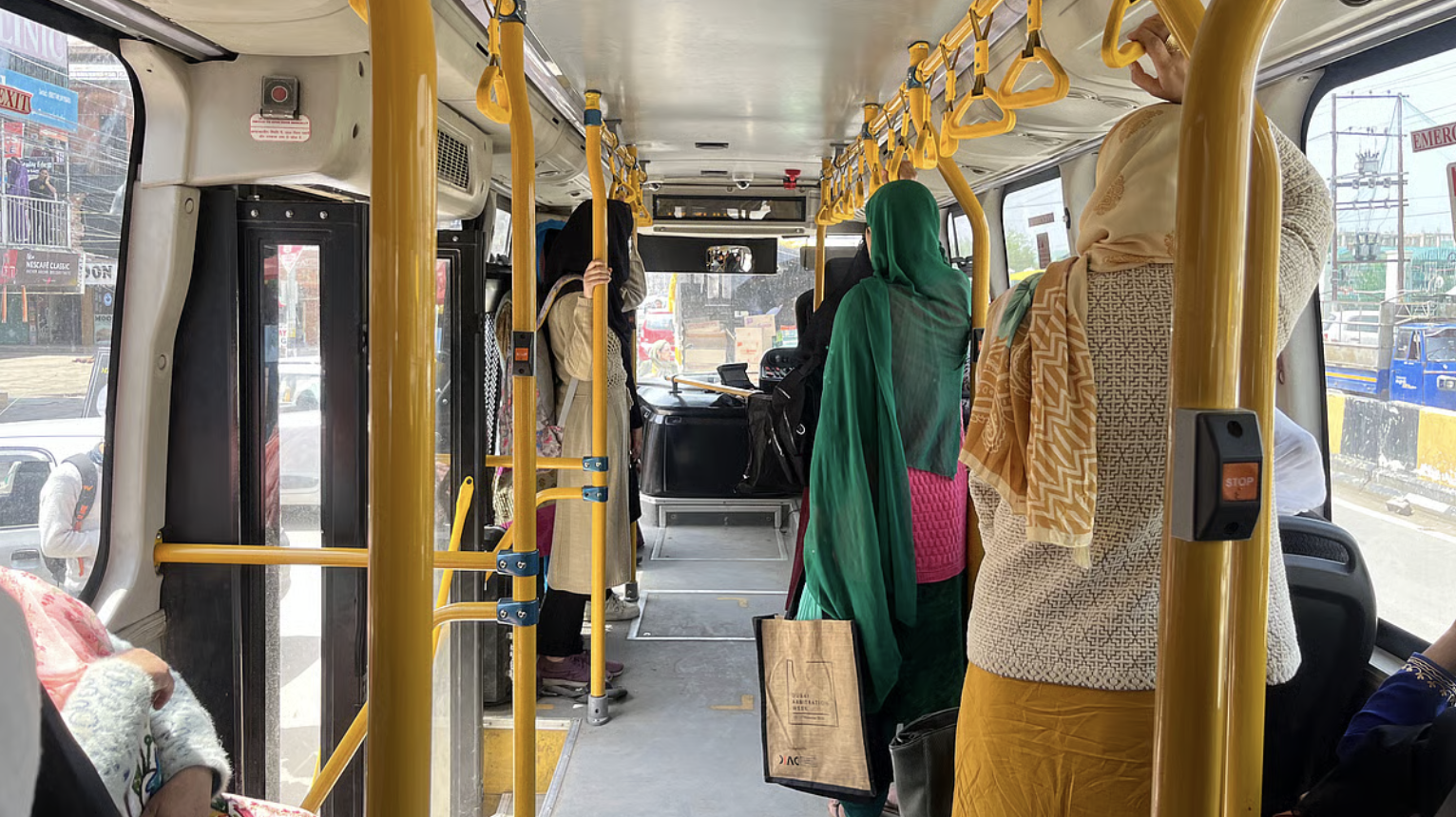
‘As a Kashmiri woman and a working professional, I feel deeply disturbed by the harassment on public buses I witness every day. Once, while travelling on a red bus from Lal Bazar to Lal Chowk, a man standing behind me kept deliberately pushing up against me and trying to touch me inappropriately. I tried to get away, but he didn’t stop. When | confronted him, no one, neither the passengers nor the conductor, stepped in,’ said Aliya Bashir.
She further recalled, ‘The bus kept moving as if nothing had happened. That moment shook me and made me realise how normalised harassment still is on public transport. After that, I stopped travelling on red buses altogether because even if the service is free, my safety is far more important.‘
In a country of 1.4 billion people, public transportation is the backbone of daily life. It connects millions to jobs, education, and healthcare, facilitating social inclusion and productivity. Yet for nearly half of India’s population — its women and girls — this vital system of transportation often becomes a barrier instead of a bridge.
Every morning, buses across Srinagar fill with students going to colleges, women heading to offices, workers starting yet another long day, and families rushing through the normal grind of city life. Public transport is a necessity and is supposed to be a safe, shared space. However, for many women, stepping onto a bus is never just another commute.
In a country of 1.4 billion people, public transportation is the backbone of daily life. It connects millions to jobs, education, and healthcare, facilitating social inclusion and productivity. Yet for nearly half of India’s population — its women and girls — this vital system of transportation often becomes a barrier instead of a bridge.
An often unnoticed battle
Uncomfortable experiences on buses don’t always involve highly visible forms of harassment. Sometimes it is a lingering stare. Other times, it is a man who sits too close despite an abundance of space. It can also be a quick comment. And ever so often, it is the deliberate, slow brush of the hand against one’s body. These are moments so small that others may take no notice, but they stay with women long after the ride is over.
Speaking to FII, Yashika Butt, a Kashmiri student from Anantnag, recalls one such incident. She says, ‘I still remember it clearly. I was in Grade 10. The bus was really crowded, and two boys standing next to me started rubbing up against me. I wanted to react, but I was too scared to speak up, afraid of being blamed for something they had done. So I got off at the next stop and walked the rest of the way home.‘ Asked if she still takes public transport, she says, ‘I don’t think that such harassment will ever completely stop. My father bought me a scooter recently, so now I travel using my scooter.‘
Sahiba Showkat, now 39 years old, recalls an incident from when she was a university student. ‘I got on the bus and sat down. After a while, an old man came and sat down next to me. Gradually, he put his hand on my belly. I was scared, and I froze. I couldn’t say a word. He eventually stepped off the bus as if he hadn’t done anything wrong, but I was left scared and speechless. I didn’t even tell my family because I couldn’t bring myself to. The silence hurt almost as much as the incident itself.‘
Women change routes, avoid the crowded evening buses, pretend to take calls, carry safety pins, and share their locations with friends to feel safer. However, these measures can only do so much when such acts of harassment are committed with impunity and within a culture of silence
Women change routes, avoid the crowded evening buses, pretend to take calls, carry safety pins, and share their locations with friends to feel safer. However, these measures can only do so much when such acts of harassment are committed with impunity and within a culture of silence
Sadiya Masoodi, a Srinagar-based student, told FII, ‘I have experienced harassment on public transport before; someone touched me inappropriately once. However, I immediately spoke up and asked, “Why are you touching me?” and said, “Can you please move aside?” Such behaviour should never be tolerated. I think many stay silent because they are scared of being judged, especially in a conservative society like ours. But as young women, we do not have to put up with this anymore. We can call out this behaviour.’
The norm rather than the exception
Harassment on public buses is not the exception; it’s the norm, and that’s the real crisis. As per NCRB data, India recorded 4.45 lakh cases of crimes against women in 2022, which accounts for one case every 51 minutes. CNN-News18’s She Shakti Suraksha Survey 2025 found that 7 per cent of women experienced harassment in public spaces.
As per the findings of the National Annual Report and Index on Women’s Safety (NARI) 2025, public transport was noted to be one of the most common sites where sexual harassment took place, accounting for 29 per cent of cases. Another study showed that 56 per cent of urban women have experienced harassment on public transport in India.
Utilising public transport continues to be one of the least comfortable parts of women’s daily lives. While the law has provisions to address such sexual harassment, its implementation leaves much to be desired.
Utilising public transport continues to be one of the least comfortable parts of women’s daily lives. While the law has provisions to address such sexual harassment, its implementation leaves much to be desired. Speaking to FII, Syed Sehrish, a Srinagar-based lawyer, says, ‘I believe that the Bharatiya Nyaya Sanhita (BNS), particularly sections 73, 74, and 79, provide a strong legal framework for addressing harassment against women in public transport. However, the problem lies with the implementation of these regulations.‘
Further adding, ‘Cases are underreported, there is often a delay in police action, CCTV cameras remain nonfunctional, and transport employees are ignorant towards gender issues, all of which mean women continue to feel unsafe despite the presence of laws. Safety cannot only be a matter of creating laws. It should involve efficient policing, trained and sensitised transport staff, and an approach of zero tolerance.‘
Fear shapes how women move through public spaces
There are also opportunity costs and emotional costs that are rarely acknowledged when speaking of sexual harassment on public transport. Fear shapes the way women move through cities, and this impacts their educational prospects and job opportunities, as well as their emotional well-being and the exercise of their autonomy.
Women’s daily battles for safety often go unnoticed. This is not because instances of harassment go unseen, but because they are overlooked. Sexual harassment on public transport is women’s everyday reality. However, this leaves us with one question: if everyone knows how unsafe public transport is for women, then why does the burden of safety still fall entirely on them?
Quotes in this article have been edited for length and clarity.




This is absolutely a reality that many Kashmiri women, including me has faced. I dread public transport system in Kashmir but its unavailability also cripples any liberty of movement that I have.
Reading this was heartbreaking. No woman should have to experience fear, discomfort, or harassment while simply trying to travel. The article powerfully highlights how public spaces often fail women, especially in regions where these issues remain underreported. Thank you for giving voice to experiences that many silently carry every day.
Public transport should never feel like a battlefield for women. The constant staring, harassment, and fear described in this article are not “small issues” — they are serious violations of safety and dignity. Society needs to stop normalising this behaviour and start demanding accountability and safer public spaces for women everywhere.
A powerful and necessary read. The silent struggles women face during everyday travel deserve far more attention and action. Safety should be a basic right, not a privilege.